A test-optional policy forced by a lawsuit, recast as equity's confession.
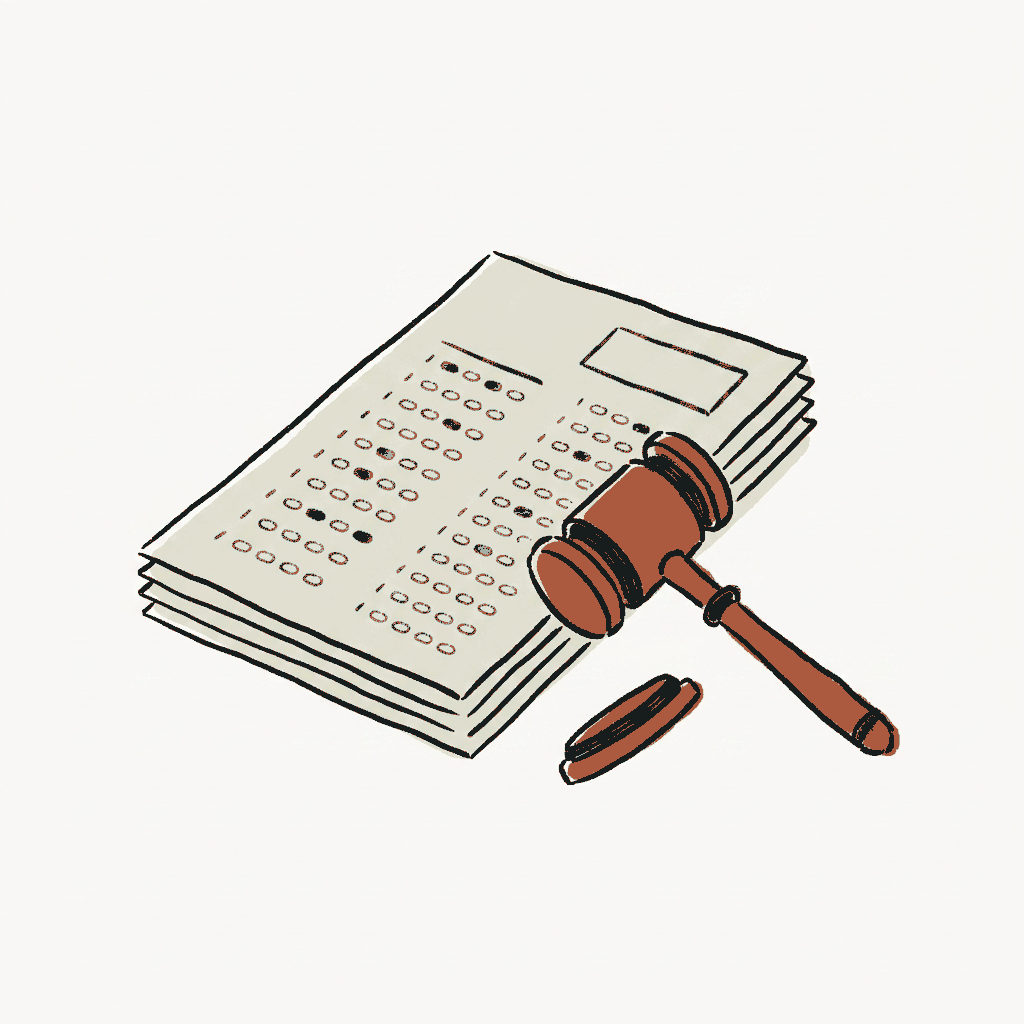
Roughly 3,000 University of California faculty signed letters this July asking for the SAT to come back, citing students unprepared for college-level work. A finance-commentary account read that as proof UC's 2020 test-optional shift was never about equity, it was cover for lowering standards.
UC didn't drop the SAT on its own timeline. A discrimination lawsuit forced the issue, and a court injunction locked in the change months before anyone could call the rationale a free choice.
The faculty complaints are real, and so is the fact that the policy never produced the demographic shift either side expected. Neither finding proves the other side's motive.
Three checks: on how UC's 2020 decision actually got made, on what's driving the preparedness complaints, and on whether the test-optional years moved admissions demographics at all.
Being right about what happened and wrong about what it proves are different failures, so these two lines never get averaged into one score. How this works
The logic check
If the claim is right, these things should be true. Here's what we found. Each check says which version of the claim it's testing, the plain one most people would hear or the widest one the same words could carry, and whether it carries the claim's own burden or establishes the background it sits on.
If 'equity' were pretextual rather than the genuine driver (the strongest reading), UC's 2020 decision should not trace to an external legal/civil-rights forcing mechanism independent of UC's own preference, it should look like a freely chosen ideological project.
Reading failsThe decision traces to Smith v. Regents of the University of California, filed December 2019 by students, the Compton Unified School District, and civil-rights attorneys (including Lisa Holder), alleging SAT/ACT use unlawfully discriminated against disabled, low-income, Black, and Latino applicants. An Alameda County Superior Court judge issued an injunction in August 2020 barring UC from using the tests even for scholarships, hardening the switch on a court timeline rather than a freely chosen one, and a May 2021 settlement permanently barred their use through 2025. source
If declining preparedness (the minimal reading) is real and specifically attributable to dropping the SAT, faculty accounts of the decline should isolate testing policy from other confounds like pandemic-era learning loss, grade inflation, or new AI tool use.
Reading strainedUC Berkeley faculty analysis found the share of incoming students severely unprepared for introductory calculus nearly doubled between 2021 and 2023, and math professor Mina Aganagic said students now struggle with material 'taught in elementary and middle school.' But the same faculty letters attribute the decline to a mix of causes, including 'grade inflation and increased AI usage in coursework,' not to the testing-policy change alone, and the 2021-2023 window overlaps the well-documented national pandemic learning-loss period. source
If dropping the SAT had genuinely served equity as its own proponents intended (undercutting the 'it was always pretextual' strongest reading, though not proving the opposite), we would expect a measurable shift toward underrepresented/low-income enrollment attributable to the post-2020 test-free cycles.
Reading strainedAn independent statistical analysis of UC's own admissions data found no significant shift in demographic composition following the 2020-21 policy change (p=0.324); the meaningful prior gains in underrepresented enrollment occurred in the 2019-2020 cycle, before the test-free policy took effect. Equity advocates separately point to UC's own studies finding admits under the test-free policy are 'equally, if not more, qualified' than earlier cohorts, a claim we did not independently verify against the same dataset. source
The full scoring
The raw numbers behind the verdict. What R/I/P/E/L and charge stages mean: how we score.
Research verdict: mixed evidence. The research found some of what the claim predicts and not the rest.
The claim is that UC's 2020 decision to drop the SAT was never about equity but about lowering standards, and faculty complaints about unprepared students prove it. Read widely, the pretext charge fails: the decision traces to Smith v. Regents, a discrimination lawsuit filed in December 2019, and an August 2020 court injunction locked the change in. Read narrowly, the complaints are real but tangled: UC Berkeley faculty found the share of students severely unprepared for calculus nearly doubled between 2021 and 2023, yet the same letters blame grade inflation and AI use too, and the window overlaps pandemic learning loss. An independent analysis found no significant demographic shift after the policy. None of this proves either side's motive.
Source record: hobocode.net Fault Line Report 2026-W32
The Fault Line Report, August 3 to 9, 2026
All fourteen narratives with the full logic test, the mirror check, the R/I/P/E/L factors and the coverage notes on each lane. This page is the plain-language cut; that one is the whole thing, including the polarization methodology that defines every score here.